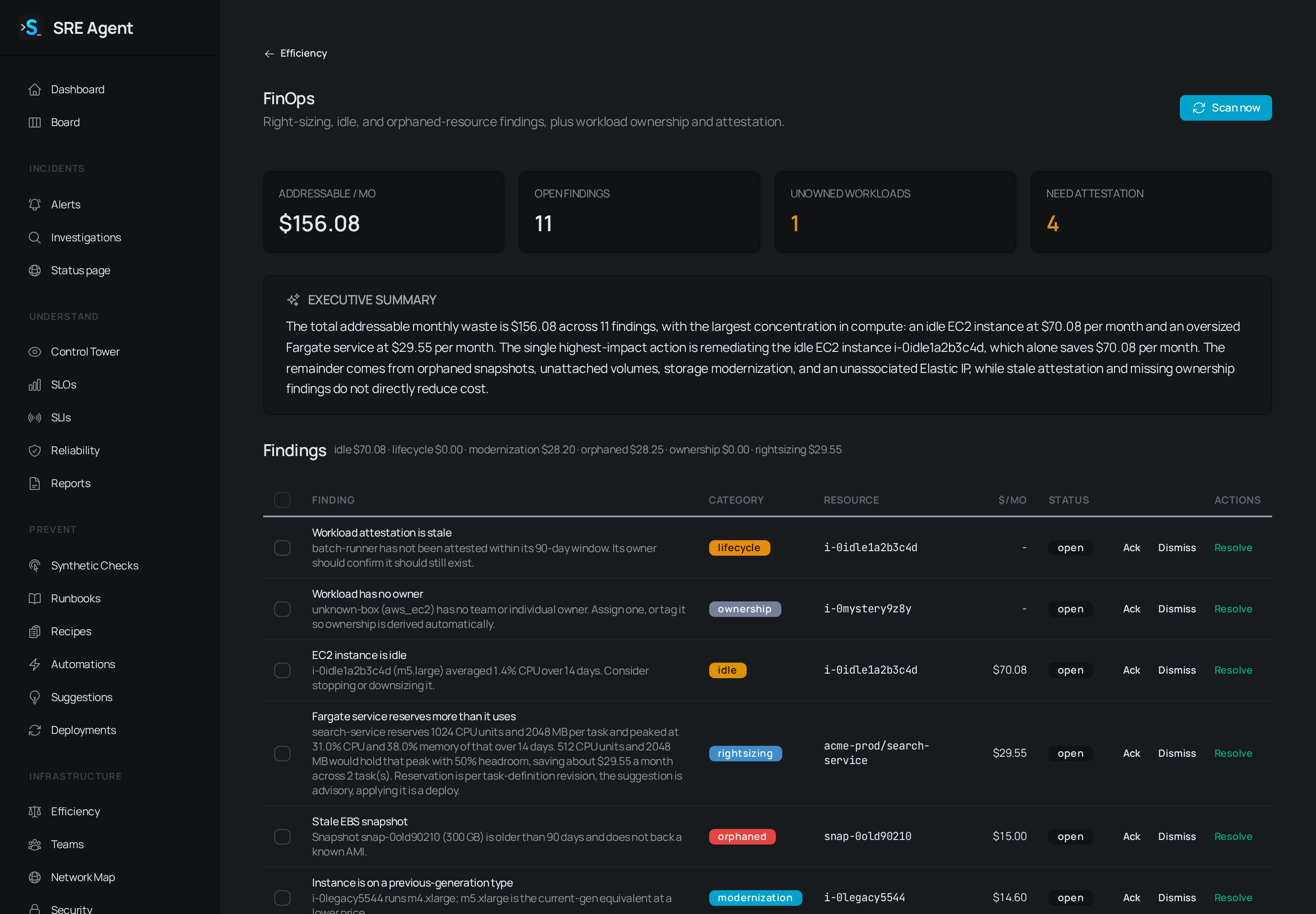
The FinOps page shows addressable monthly cost, the executive summary and a findings table that lists idle, orphaned, unowned and right-sizing findings with estimated monthly savings.
See the whole estate on Efficiency
1
Open Efficiency
Click Efficiency in the Infrastructure section of the sidebar. Three tiles summarize the
estate: Reclaimable (monthly saving from idle or over-provisioned workloads), At risk
(workloads running hot) and Unowned (workloads nobody would be told about).
2
Pick a view
The tabs are All, Waste, Risk, Unowned and Unmeasured. Each row shows the
workload, its owner, its utilisation, a size label (Idle, Over-provisioned,
Right-sized, Saturated or Not measured) and the monthly opportunity.
3
Open the detail
Click Cost detail for findings and ownership, which is the FinOps page below. Capacity
detail holds the forecast.
Not measured means the workload was discovered but no utilisation reading came with it. It is
not the same as right-sized. If nothing is measured, run a scan from Cost detail and check
that the metrics data source for the account is connected.
Work the findings
1
Open Cost detail
The FinOps page starts with four tiles: Addressable / mo, Open findings, Unowned
workloads and Need attestation. A line under them says what the last scan read and how
fresh it is. Findings can be a little behind the AWS console.
2
Scan
Click Scan now (member role). The page tells you the scan is queued and refreshes when it
finishes.
3
Read the summary and the table
The Executive summary is a short narrative over the numbers in the tiles. It never
introduces figures of its own. Each finding row has a title, description, category, the
resource, the saving in
$/mo and a status. The categories are rightsizing, idle,
modernization, orphaned, ownership and lifecycle. When the page can tell who created a resource,
it says so under the finding.4
Decide
Click Ack to say you have seen it, Dismiss if it is not worth acting on, or Resolve
once the resource is fixed or removed. To handle several at once, tick the rows and use Ack,
Dismiss or Resolve in the bar that appears.
Assign owners and attest
The Workload inventory below the findings lists every active workload with its source (k8s, ECS, EC2 or Lambda), its owner and whether it is attested.1
Filter to the worklist
Use the Owner menu: All, Unowned, or one of your teams. Teams come from the
Teams page.
2
Assign an owner
Pick a team or a person from the owner menu on the row. To do many at once, tick the rows,
choose from (assign owner) and click Apply. (clear owner) removes the owner on
purpose.
3
Confirm a suggestion
When SRE Agent can tell which person created a workload and that name resembles a member’s
address, the row shows an inferred badge and a Confirm button with that address. Nothing
is assigned until you click it. With rows ticked, Confirm N suggestions accepts every
unambiguous one.
4
Attest
Click Attest on a workload to record that somebody checked it still belongs. The status
shows current or lapsed. The number box on the row sets how many days an attestation
lasts. The date box sets when a workload is expected to be gone, and an overdue date raises a
finding.
Who can do what
Everyone can read both pages. Scanning, owners, attestation and finding status need the member role.What happens next
Findings you acknowledge, dismiss or resolve drop out of the open count, and the Addressable / mo tile and the summary update. Control Tower can raise cost findings too.Related
- Connect AWS with a read-only role: connect AWS so there is something to price.
- Manage people and roles: teams that own workloads.
- Use the Control Tower: cost findings can also arrive here.